What to Say:Ready-To-Use Templates
A quiet change in federal law now threatens to ban nearly all hemp products starting December 11, 2026, putting consumers, farmers, and small businesses at risk. Most people in our communities have no idea this is coming, or that there is still time to push for sensible regulation instead of an outright ban.
The messages on this page are plug‑and‑play templates you can use in social posts, emails, texts, and group chats to help your friends, customers, and followers understand what is happening and why “regulate, don’t ban” is the better path. Choose one that fits your voice, personalize it with a line or two about your own experience with hemp, and start spreading the word so our networks are informed and ready to act.
Social Media Posts
Facebook
Congress ended the shutdown by passing H.R. 5371, and quietly slipped in Section 781, a provision that could effectively ban most hemp‑derived THC products nationwide.
That means:
-
A $28 billion legal market at risk
-
328,000 jobs in farming, manufacturing, retail, and distribution on the line
-
Tens of thousands of small businesses that played by the rules now facing closure
This wasn’t done with public hearings or honest debate.
Learn what’s happening and message your members of Congress in just a few clicks:
 advocacy.greenfinancialservice.com
This new federal hemp law isn’t just about products on shelves. It’s about:
Farmers who planted legal crops
Small shops that followed the rules
Workers whose paychecks depend on the hemp‑derived market
Section 781 now puts hundreds of thousands of jobs and tens of thousands of small businesses at risk across the country.
We still have time to fix it.
Get the facts and send a ready-to-use message to your members of Congress here:
🔗 advocacy.greenfinancialservice.com
I don’t usually post stuff like this, but this one is huge.
Congress quietly changed the federal definition of hemp in the bill that reopened the government. If nothing changes, most hemp‑derived products (CBD, Delta‑8, THCA, etc.) could be gone by late 2026, and 328,000 people could lose their jobs.
If you care about hemp access, small businesses, or just basic transparency in government, please take 2 minutes to contact your representatives here:
✉️ advocacy.greenfinancialservice.com
After you send your message, share this post so more people hear about it.
Hemp has been legal and regulated since the 2018 Farm Bill. Instead of improving regulation, Congress just moved to re‑criminalize most hemp‑derived THC products through a last‑minute rider in a must‑pass bill.
That’s not smart policy. It’s not transparent. And it’s not how democracy is supposed to work.
If you support “regulate hemp responsibly, don’t ban it in the shadows”, tell Congress here:
👉 advocacy.greenfinancialservice.com
Please like, comment, and share to help this reach more people.
If you use CBD, Delta‑8, THCA, or other hemp products, this is directly about you.
A new federal law could wipe out 95% of the hemp‑derived market, forcing millions of consumers away from regulated options and putting 328,000 jobs in danger.
You can see what’s going on and send a pre-written message to your senators and representative in just a couple of minutes here:
📣 advocacy.greenfinancialservice.com
Drop a ✅ in the comments after you’ve sent your message so others see it’s quick and easy
X / Twitter
Congress ended the shutdown by passing H.R. 5371 and quietly slipping in Section 781, which could ban most hemp‑derived THC products and kill 300k+ jobs.
Learn what it does + email your reps in 2 minutes:
🔗 advocacy.greenfinancialservice.com
Use CBD, Delta‑8, THCA or other hemp products? A new federal law (Section 781) could wipe out 95% of that market by late 2026.
Take 2 mins to contact your members of Congress:
✉️ advocacy.greenfinancialservice.com
Section 781 doesn’t just hit products. It hits farmers, manufacturers, shop owners, and 300k+ workers who followed the rules after the 2018 Farm Bill.
Stand with them.
👉 advocacy.greenfinancialservice.com
#SaveHempJobs
If you care about hemp access, small business, or basic transparency in DC, please do this today:
1️⃣ Go to advocacy.greenfinancialservice.com
2️⃣ Send the pre‑written message to your reps
3️⃣ RT this so more people see it
#ProtectHemp #RegulateDontBan
A last‑minute hemp rider in the shutdown bill puts a $28B market, 300k+ jobs, and tens of thousands of small businesses at risk.
If you support “regulate, don’t ban,” tell Congress here 
advocacy.greenfinancialservice.com
A massive change to federal hemp law was buried in a must‑pass shutdown bill. No hearings. No real debate.
Major policy shouldn’t be made in the shadows.
Tell Congress to fix Section 781:
advocacy.greenfinancialservice.com
#ProtectHemp #RegulateDontBan
This isn’t just about gummies. It’s about whether Congress can quietly erase a legal $28B industry in one vote.
If that worries you, tell your reps to fix Section 781:
advocacy.greenfinancialservice.com
#ProtectHemp
Congress just put: $28B in hemp demand 300k+ jobs tens of thousands of small businesses
…on the chopping block with Section 781.
Take 2 mins to tell them to reverse it:
advocacy.greenfinancialservice.com
Text Messages
Quick Casual
Hey, wild update: Congress just changed the federal hemp rules so that even a lot of CBD is basically treated as illegal again. Didn’t you start giving your dog CBD? It might get way harder to find (and a lot more expensive) soon because they effectively re‑criminalized hemp after 7 years of it being legal.
If you want to push back, this site explains what’s going on and lets you message your reps in like 2 minutes: advocacy.greenfinancialservice.com
Hey, random but important: Congress just passed a law that could recriminalize 95% of hemp products and eliminate 300k+ jobs next year. I’m using this site to message my reps: advocacy.greenfinancialservice.com
I’m pretty freaked out about this new federal hemp law, it could shut down a $28B industry and kill a lot of local jobs. I just used this site to contact my members of Congress: advocacy.greenfinancialservice.com
If you have 2 minutes, please do it too.
This feels like your kind of issue:
Congress buried a huge hemp crackdown in the shutdown bill, no hearings, no real public debate, and it could ban most hemp‑derived products by 2026. So much for transparency.
If that annoys you as much as I think it will, you can hit your reps here: advocacy.greenfinancialservice.com
Didn’t you say CBD/Delta‑8 was the only thing that helped you sleep?
Congress quietly slipped in a new hemp law that could wipe out most of those products and jack up prices on what’s left. They basically rolled back the 2018 hemp rules without any real debate.
I used this tool to email my reps about it: advocacy.greenfinancialservice.com
Have you heard about the federal hemp ban they slipped into the shutdown bill? It could kill tens of thousands of small businesses. You can see what’s going on and contact Congress in like 2 minutes here: advocacy.greenfinancialservice.com
FYI: Congress just put 300k+ hemp jobs at risk by quietly changing the federal hemp rules. If you want to keep hemp legal but regulated, you can email/call your reps here: advocacy.greenfinancialservice.com
I know you use hemp stuff too, so sharing this: new federal law could ban most hemp‑derived products by late 2026. I’m asking my reps to fix it using this tool: advocacy.greenfinancialservice.com
Can you send a message too?
I remember you saying CBD helped more than pain meds after the kids were born.
Heads up: a new federal law could make a lot of CBD products way harder to get and way more expensive. They quietly changed the hemp rules in the shutdown bill.
I’m asking my reps to fix it here if you want to do the same: advocacy.greenfinancialservice.com
Group Announcements
Quick heads up for everyone:
Congress quietly attached a hemp ban (Section 781) to the bill that ended the government shutdown. It could wipe out most hemp‑derived products, kill 328,000 jobs, and shut down tens of thousands of small businesses by late 2026.
There’s a site that explains it and gives you ready‑to‑send messages to your reps: advocacy.greenfinancialservice.com
Please take 2-3 minutes to send a message and share this with at least one other person.
This isn’t just about hemp products; it’s about local jobs and small businesses. A new federal law (Section 781) could erase a $28B market and 300k+ jobs.
I’m asking everyone in this group to take 5 minutes today to contact Congress here: advocacy.greenfinancialservice.com
The site has background info, call/email scripts, and a tool to look up your reps. Please share it once you’ve taken action.
If you use CBD, Delta‑8, THCA, or other hemp products, this directly affects you. A new federal law could wipe out almost all of those options.
You can read what’s happening and send a pre‑written message to your reps here: advocacy.greenfinancialservice.com
Please take a minute to do it and drop a ✅ once you’ve sent yours so others see it’s easy.
Whatever your politics, this should bug you: Congress used a must‑pass shutdown bill to sneak in Section 781, a major policy change that never got a clean, public vote. If you care about transparency and accountability, take 2 mins here: advocacy.greenfinancialservice.com
Hemp is in real trouble. Congress just changed the definition of hemp in a way that could ban most hemp‑derived THC products and devastate farmers, retailers, and manufacturers.
If you want to help:
Go to advocacy.greenfinancialservice.com
Use the templates there to email/call your members of Congress
Forward this message to a few friends who care about hemp, small business, or personal freedom.
Numbers are everything right now.
Over the next year, Congress decides whether to let a quiet federal hemp ban stand or fix it. If they do nothing, most hemp‑derived products could be illegal again in 2026.
Use this site to tell your members of Congress to regulate, don’t ban: advocacy.greenfinancialservice.com
If you care about hemp access, farmers, or small businesses, this is the moment to speak up.
This isn’t just about hemp, it’s about how Congress makes laws. They buried a huge hemp crackdown (Section 781) inside the shutdown bill with no real hearings or debate. That’s not how democracy should work. If you care about process, this explains it + lets you message your reps: advocacy.greenfinancialservice.com
If Congress can quietly rewrite hemp law in a spending bill, they can do it to any issue they don’t want to debate in public. Section 781 is a bad precedent for democracy, period. Quick rundown + easy way to contact your reps: advocacy.greenfinancialservice.com
Emails
Personal to Friends/Family
Subject: Why I’m asking you to help stop the new hemp ban
Hi [Name],
I’m reaching out personally because something major happened in D.C. that almost no one knows about, and it directly affects millions of people and thousands of small businesses.
As part of the recent government spending deal (H.R. 5371), Congress quietly passed Section 781, which rewrites the federal rules for hemp in a way that will effectively ban most of the hemp‑derived products people use today, things like infused beverages, gummies, vapes, and other cannabinoid products sold outside of state-licensed cannabis systems. Legal experts are already warning that this will shrink the consumer-facing hemp industry and push many products back into “illegal” status under federal law.
This is a huge deal because:
Tens of millions of Americans use hemp‑derived products, and a large share do so for stress, sleep, pain, or to reduce alcohol use.
Section 781 was slipped into a must‑pass spending bill with no real public debate, even though it will wipe out large parts of an entire legal industry.
It sets a dangerous precedent: if lawmakers can quietly dismantle a market this big in the fine print, they can do it to other industries too.
I’ve found a great site, advocacy.greenfinancialservice.com, that explains what Section 781 does in plain language and gives people an easy way to contact their lawmakers. On the website you can:
Learn what the new rules actually change.
See how they impact consumers, farmers, and small businesses.
Email, call, or tweet your Representative and Senators in just a few clicks.
If you’re willing to help, here’s what I’m asking:
Take 3 to 5 minutes to go to advocacy.greenfinancialservice.com and use the tools there to contact your lawmakers.
Forward that link to a few people you trust or share it on your social media so more people know what’s happening.
This isn’t just a “hemp industry” issue; it’s about whether major changes that affect millions of people happen out in the open, or behind closed doors. A small number of calls and emails from each of us can make a real difference in whether Congress reconsiders or fixes this language.
Thank you for reading this and for anything you’re able to do.
[Your Name]
Subject: Quick favor on the new hemp ban
Hi [Name],
I’m sending this because Congress just slipped a major hemp restriction (Section 781 in H.R. 5371) into the recent spending bill, and almost no one is talking about it. It effectively bans most hemp‑derived consumer products, gummies, vapes, beverages, and more, that millions of people legally use today, and it puts thousands of farms and small businesses at risk.
I found a site advocacy.greenfinancialservice.com, which explains what Section 781 does and makes it easy to contact your lawmakers. In a couple of minutes you can email, call, or tweet your Representative and Senators directly from that page.
If you can:
Visit advocacy.greenfinancialservice.com
Use the tools to send a quick message
Share the link with a few friends
I’d really appreciate it. Moments like this are exactly when a handful of voices can change what happens next.
Thank you,
[Your Name]
Subject: A huge, quiet hit to the hemp economy
Hi [Name],
I wanted to flag something big that just happened with hemp, and how it impacts real people, jobs, and the broader economy.
Using the latest national economic data, analysts estimate that the hemp‑derived cannabinoid industry supports about 328,000 jobs, pays roughly $13 billion in wages, and drives more than $79 billion in total economic impact across the U.S. economy. Tens of millions of Americans buy these products, and that spending supports farmers, manufacturers, truck drivers, retail workers, and countless small businesses in all 50 states.
Section 781, which was tucked into the recent federal spending bill, fundamentally changes the definition and limits for hemp products in a way that could wipe out most of this industry, with many experts warning that the majority of current products will effectively be banned. All of this was done in a rush, with no meaningful public hearings or broad debate, despite the scale of the economic damage and the number of people whose livelihoods depend on this market.
To help explain what’s going on and make it easy for people to respond, I’ve found a site advocacy.greenfinancialservice.com. The site:
Breaks down what Section 781 does in plain language
Outlines the economic stakes for workers, businesses, and communities
Lets you quickly email, call, or tweet your lawmakers from one place
If you’re willing, it would mean a lot if you could:
Visit advocacy.greenfinancialservice.com
Use the tools there to contact your Representative and Senators
Share the link with a few people who might care about jobs, small businesses, or civil liberties
Thanks for taking a minute to read this and for anything you can do.
[Your Name]
Business/Professional
Subject: Significant federal change impacting the U.S. hemp economy
Dear [Name],
I am reaching out to flag a major federal policy change that is about to reshape a fast‑growing part of the consumer economy.
Recent national data estimate that the hemp‑derived cannabinoid sector supports roughly 328,000 jobs, pays around $13 billion in wages, and generates more than $79 billion in total economic impact across the United States. Tens of millions of Americans purchase these products, and that demand supports farms, manufacturers, logistics, and retailers in every region of the country.
Section 781 of the latest federal spending bill (H.R. 5371) substantially narrows the federal definition of hemp and will effectively prohibit most existing hemp‑derived consumer products, with legal and industry analysts warning of large‑scale business closures and job losses. These changes were advanced through a must‑pass appropriations vehicle, without the kind of public hearings or robust stakeholder process that an industry of this size would typically receive.
To help business owners, professionals, and community leaders understand what is happening and how to respond, we recommend advocacy.greenfinancialservice.com. The site summarizes the new rules in plain language, outlines the economic implications, and provides tools to contact federal lawmakers in a structured, professional way.
If this touches your organization, your customers, or your community, I would encourage you to review the information there and consider engaging with your elected officials.
Best regards,
[Your Name]
Subject: Federal hemp rule change – implications for our industry
Dear [Name],
I’m writing to make you aware of a federal development that could materially affect hemp‑derived product lines, related services, and upstream and downstream partners.
Current industry research indicates that the U.S. hemp‑derived cannabinoid market supports roughly 328,000 jobs and generates tens of billions of dollars in annual economic activity, with a consumer base in the tens of millions. This activity spans cultivation, processing, manufacturing, distribution, retail, and professional services, and has become a non‑trivial component of local and state economies.
Section 781 of H.R. 5371, enacted as part of the recent continuing appropriations package, substantially restricts what qualifies as lawful hemp at the federal level and is expected to render a majority of current hemp‑derived consumer SKUs noncompliant. Because this was embedded in budget legislation rather than addressed through a standalone bill with sector‑specific hearings, many affected businesses and stakeholders had little to no opportunity to provide input before these changes were finalized.
To help companies and professionals quickly get up to speed and, if they choose, communicate with policymakers, we recommend advocacy.greenfinancialservice.com. The site aggregates key information on Section 781 and offers tools to contact federal legislators efficiently.
If you’d like to discuss how this may intersect with your operations, clients, or customers, I’m happy to connect.
Best,
[Your Name]
Subject: Federal hemp rule change – implications for our industry
Dear [Name],
I’m writing to make you aware of a federal development that could materially affect hemp‑derived product lines, related services, and upstream and downstream partners.
Current industry research indicates that the U.S. hemp‑derived cannabinoid market supports roughly 328,000 jobs and generates tens of billions of dollars in annual economic activity, with a consumer base in the tens of millions. This activity spans cultivation, processing, manufacturing, distribution, retail, and professional services, and has become a non‑trivial component of local and state economies.
Section 781 of H.R. 5371, enacted as part of the recent continuing appropriations package, substantially restricts what qualifies as lawful hemp at the federal level and is expected to render a majority of current hemp‑derived consumer SKUs noncompliant. Because this was embedded in budget legislation rather than addressed through a standalone bill with sector‑specific hearings, many affected businesses and stakeholders had little to no opportunity to provide input before these changes were finalized.
To help companies and professionals quickly get up to speed and, if they choose, communicate with policymakers, we recommend advocacy.greenfinancialservice.com. The site aggregates key information on Section 781 and offers tools to contact federal legislators efficiently.
If you’d like to discuss how this may intersect with your operations, clients, or customers, I’m happy to connect.
Best,
[Your Name]
Email Signature Block
| Protect legal hemp: advocacy.greenfinancialservice.com |
| Learn what Section 781 means and take action: advocacy.greenfinancialservice.com |
| Make your voice heard on hemp policy – contact your lawmakers here . |
| Stand up for hemp jobs and small businesses: advocacy.greenfinancialservice.com |
Newsletter
Subject ideas
“Urgent: Quiet federal move could wipe out the hemp market”
“Hemp at risk: jobs, consumers, and what you can do in 3 minutes”
Body template
Header
Hemp Is Under Threat – Here’s What Just Happened
What changed
Congress recently passed a spending bill (H.R. 5371) that includes Section 781, a provision that dramatically tightens the federal rules for hemp‑derived products. Legal and industry analysts warn that most of the hemp‑derived products people buy today, like gummies, beverages, tinctures, and vapes, could effectively become illegal under federal law.
Why it matters
This isn’t just about exotic hemp products, it reaches into everyday life. Section 781 threatens the CBD people put in their coffee, the drops your parents or grandparents swear by for sleep and pain, and even the CBD chews many give their aging dogs for arthritis or anxiety. These are now normal, mainstream wellness choices for millions of households, and they are being put at risk without hearings, debate, or honest public explanation.
The hemp‑derived cannabinoid sector supports an estimated 328,000 jobs in the United States and more than $79 billion in total economic impact.
Tens of millions of Americans use hemp‑derived products, many for wellness, pain, sleep, or as alternatives to alcohol and other substances.
Section 781 was tucked into a must‑pass appropriations bill, without the kind of public hearings or open debate that a change of this scale would normally receive.
This is not just a “hemp industry” issue, it touches farmers, manufacturers, retailers, workers, patients, veterans, and consumers in all 50 states.
What you can do in 3 minutes
To make this easy, we’ve built a one‑stop advocacy hub: advocacy.greenfinancialservice.com.
On this site you can:
Learn – Read a plain‑language breakdown of Section 781 and what it changes.
See the impact – Understand the jobs, businesses, and communities at risk.
Act – Use built‑in tools to email, call, or tweet your Representatives and Senators with just a few clicks.
Call to action
If you believe major economic and public‑health decisions should not be made behind closed doors, this is the time to speak up.
Contact your lawmakers using the tools there
Share the link with friends, family, and colleagues who care about jobs, small businesses, and fair democratic process
Every message helps signal that voters are paying attention to how hemp policy is being made.
Call Scripts
Elevator Pitch
“Hi, my name is [Name], I live in [City, State, ZIP], and I’m a constituent.
I’m calling about Section 781 in H.R. 5371 and the new federal hemp rules. I’m asking [Senator/Representative] to support efforts to amend or repeal this language.
The hemp‑derived industry supports hundreds of thousands of jobs and tens of billions of dollars in economic activity, and Section 781 would wipe out most of that overnight, without proper hearings or debate. Please work to protect hemp jobs and push for a more reasonable regulatory approach.
Can I count on [Senator/Representative] to oppose the hemp ban in Section 781 and support fixing it?”
“Hi, my name is [Name], I’m a constituent in [City, State, ZIP].
I’m calling about Section 781 in H.R. 5371. I want [Senator/Representative] to support changing or repealing this section.
Section 781 doesn’t just target exotic products, it affects everyday CBD that people use for sleep, pain, stress, and even for their pets. This is now a mainstream wellness market used by millions of families, and shutting it down through a buried provision in a spending bill is not acceptable.
Please stand up for consumers and ask leadership to fix or roll back Section 781.”
“Hello, my name is [Name], and I’m a constituent from [City, State, ZIP].
I’m calling to express concern about how Section 781 on hemp was passed as part of H.R. 5371. I’m asking [Senator/Representative] to support efforts to amend or repeal this section.
A provision that will effectively ban most hemp‑derived products and impact tens of millions of consumers was slipped into a must‑pass spending bill with no meaningful public hearings. That’s a disservice to democratic process, regardless of where you stand on hemp.
I’m asking [Senator/Representative] to push for transparent, stand‑alone legislation and to support fixing Section 781.”
“Hi, my name is [Name], I live in [City, State, ZIP], and I’m a constituent.
I’m calling to urge [Senator/Representative] to fix or repeal Section 781 in H.R. 5371. It will destroy a major hemp‑derived industry, cost hundreds of thousands of jobs, and take away CBD and other products that millions of Americans rely on, all without proper public debate.
Please oppose the hemp ban language and support a more reasonable regulatory approach. Thank you.”
Conversation Starters
“Have you heard about Section 781 and the new hemp rules? It was tucked into the latest spending bill and could wipe out most hemp and CBD products people use every day, from sleep drops to pet chews. A bunch of us are using advocacy.greenfinancialservice.com to learn what it does and message our lawmakers about it.”
“You know how a ton of people use CBD now, your parents for sleep, friends for anxiety, even CBD treats for dogs? Congress just passed a change called Section 781 that could make a lot of that effectively illegal, and it happened with almost no public debate. There’s a site, advocacy.greenfinancialservice.com, that explains it and lets you contact your reps in a couple of minutes.”
“Random question: did you know the hemp‑derived market supports hundreds of thousands of jobs and tens of billions in economic activity in the U.S.? Section 781 in the new spending bill could wipe out a big chunk of that, especially for small businesses and farmers. If you care about that kind of thing, advocacy.greenfinancialservice.com has a simple breakdown and lets you email or call Congress.”
“I’ve been bothered by how Section 781 passed, not even just the hemp part, but the process. A huge change that affects millions of consumers and a big legal industry was slipped into a must‑pass bill with almost no hearings. I’ve been pointing people to advocacy.greenfinancialservice.com so they can see what it does and tell their lawmakers to fix it.”
“Imagine if Congress quietly rewrote the rules in a budget bill and suddenly most of the products in an entire legal market, like supplements or craft beverages, were effectively banned. That’s basically what just happened to hemp and CBD with Section 781. If you want the quick version and a way to push back, advocacy.greenfinancialservice.com has all the info and a one‑click way to reach your reps.”
“I’ve been following this federal hemp thing, Section 781, and it’s way bigger than people realize. It hits normal CBD and hemp products, not just ‘stoner stuff,’ and it slid through with no real debate. If you’re curious or want to say something about it, check out advocacy.greenfinancialservice.com.”
FAQ Responses
Q: How big is the hemp‑derived industry, really?
A: The hemp‑derived cannabinoid market is a multibillion‑dollar industry supporting roughly 328,000 jobs, more than $13 billion in wages, and an estimated $79 billion in total economic impact, with tens of thousands of businesses paying taxes and supporting many other vendors and service providers across the country.
Q: Does this affect the CBD people give their pets and the CBD seniors use for sleep and pain?
A: Yes; pet CBD products and the CBD oils, capsules, and topicals many older adults use for sleep, pain, and anxiety depend on the same hemp‑derived inputs and cannabinoid profiles that are being restricted, so they are likely to be heavily impacted or pushed off the market.
Q: How many people actually use hemp and CBD products?
A: National market research shows that tens of millions of Americans use hemp‑derived products, on the order of 50 million consumers, making this one of the largest wellness and supplement markets in the country.
Q: Is it true this could wipe out 95% of the hemp products that have been sold for the last seven years?
A: Industry observers warn that the combination of strict THC caps, new definitions, and compliance burdens could remove the vast majority of existing hemp‑derived products, on the order of 90-95% of what consumers see on shelves today.
Q: How many jobs and businesses are at risk under Section 781?
A: Analysts estimate that hundreds of thousands of jobs and tens of thousands of businesses tied to hemp‑derived products, across farming, manufacturing, distribution, retail, and professional services, are exposed if most current products are forced off the market.
Q: Have legal hemp products caused enough harm to justify this kind of crackdown?
A: While there have been concerns about inconsistent quality and some bad actors, national analyses emphasize that these issues could be addressed through targeted safety and labeling standards rather than effectively dismantling an entire industry that has operated for years.
Q: How does the hemp‑derived market compare to things like craft beer or legal cannabis?
A: Recent reporting indicates that revenue from hemp‑derived cannabinoids already exceeds legal cannabis sales in many areas and is on par with or larger than the craft beer segment, putting it in the same league as markets most people see as major economic engines.
Q: What happens to consumers if these products disappear?
A: Many consumers who rely on hemp and CBD for wellness, pain, sleep, or harm reduction are likely to lose access to regulated products and may turn to unregulated or illegal sources, increasing safety risks and empowering underground markets instead of licensed businesses.
Q: Isn’t this just about “intoxicating” hemp products like Delta‑8 gummies and vapes?
A: No; while intoxicating products are a target, the new federal definitions and caps are written so broadly that they impact a wide range of hemp‑derived products, including many that consumers do not think of as intoxicating at all.
Q: How does this hurt local and state economies?
A: States and municipalities stand to lose significant tax revenue, payroll, rent, and ancillary spending tied to hemp‑derived businesses, which in turn affects landlords, suppliers, logistics companies, and service providers that depend on this ecosystem.
Q: CBD will still be legal, right?
A: Not in the way people are used to; Section 781 effectively forces CBD into highly purified, tightly limited forms, which means most current full‑spectrum and broad‑spectrum products would need to be reformulated or removed, driving costs up and shrinking choices for consumers
Q: How did such a big change pass without public debate, is this how democratic process is supposed to work?
A: Section 781 was added to a must‑pass federal spending bill rather than advanced as a stand‑alone measure with full hearings, amendments, and public input, raising serious concerns about transparency, accountability, and whether the process reflected the scale of the impact on workers, consumers, and businesses.
Letters
Letter to the Editor
Economic impact focus
To the Editor:
Congress just voted to cripple one of the fastest‑growing sectors of the American economy, and most people have no idea it happened. In just seven years since the 2018 Farm Bill, the hemp‑derived cannabinoid industry has grown into a nationwide supply chain supporting an estimated 328,000 jobs, more than $13 billion in wages, and over $79 billion in total economic impact. This includes farmers, processors, manufacturers, logistics companies, retailers, and the many service businesses that depend on them in every state.
Section 781 of the recent federal spending bill dramatically narrows the legal definition of hemp and is expected to eliminate roughly 90-95% of the current hemp‑derived product market. Industry analyses suggest that more than $28 billion in economic activity could be erased, along with tens of thousands of small businesses that have operated openly and paid taxes for years. At a time when communities are fighting to retain jobs and investment, this kind of blunt‑force policy is the opposite of economic stewardship.
If policymakers believe changes are needed, they should target bad actors and tighten safety standards, not quietly dismantle an entire legal industry that has barely had time to reach maturity. Voters deserve a transparent conversation about whether wiping out a multibillion‑dollar market, along with hundreds of thousands of livelihoods, is really what Congress intended.
Democratic process / “how this was done”
To the Editor:
Regardless of where one stands on hemp, everyone should be alarmed by how Congress just made one of the most sweeping drug‑policy changes in years. Section 781, buried deep inside a massive spending bill, rewrites the federal definition of hemp and pushes most hemp‑derived products back toward Schedule I status under federal law. This decision will affect tens of millions of consumers and a national industry that contributes tens of billions of dollars to the U.S. economy, yet there were no broad public hearings, no stand‑alone vote, and almost no public debate.
For seven years, lawmakers allowed the hemp‑derived market to develop in plain sight, with businesses registering, being inspected, and paying taxes while consumers voted with their wallets. If Congress now believes the rules were too loose, the answer should be a transparent legislative process: clear bills, expert testimony, amendments, and an honest up‑or‑down vote that constituents can evaluate at the ballot box.
Instead, one of the largest changes to hemp policy since 2018 was slipped into a must‑pass appropriations bill, shielding it from real scrutiny. That is not how democratic accountability is supposed to work, especially when the stakes involve hundreds of thousands of jobs and a legal industry that millions of Americans rely on.
Scientific and medical progress focus
To the Editor:
In just seven short years, the legalization of hemp has opened an extraordinary window for scientific and medical discovery, and Section 781 now threatens to slam that window shut. Since 2018, researchers and product developers have been able to isolate, convert, and study a wide range of cannabinoids, exploring how different compounds and terpenes affect pain, inflammation, mood, seizures, appetite, and more. The ability to convert cannabinoids from one form to another and to fine‑tune terpene profiles has already produced breakthroughs in understanding how this plant can help real patients.
This work is still in its infancy. Hemp‑derived cannabinoids and terpenoids have only recently become available at scale and in consistent, study‑ready forms, giving scientists tools they never had before. Restricting most of these compounds back into de facto illegality does not just hurt businesses; it chokes off a pipeline of research that could yield better treatments for pain, neurological conditions, metabolic disorders, and more, at a time when safer alternatives to opioids and other high‑risk drugs are desperately needed.
Hemp is a plant that grows naturally across much of the world. The responsible path is to understand it, not to demonize and ban it just as science is beginning to map its potential. Section 781 risks sacrificing a generation of medical and scientific progress because Congress chose prohibition over regulation.
Everyday CBD, pets, seniors, and THCV focus
To the Editor:
The new hemp rules in Section 781 are often described as a crackdown on “intoxicating” products, but the reality hits much closer to home. The law’s tightly drawn definitions and THC limits will also sweep up everyday CBD products and other beneficial cannabinoids that families quietly rely on. That includes the CBD oil your parents use to sleep, the capsules seniors take for joint pain, and the chews people give their aging dogs to help with mobility and anxiety.
Emerging cannabinoids like THCV, which early research and consumer experience suggest may help with appetite regulation, blood sugar, and focus, are also collateral damage in this blanket approach. Rather than setting sensible guardrails, Congress is effectively saying that if a hemp‑derived compound is too useful or noticeable, it no longer belongs in the legal market. The result will not be abstinence; it will be confusion, reduced access, and a shift toward unregulated or underground sources.
For seven years, millions of Americans have quietly integrated hemp and CBD into their wellness routines without the kind of public health crisis that would justify a near‑total rollback. If lawmakers believe improvements are needed, the answer is better standards and oversight, not a one‑size‑fits‑all prohibition that takes away the very products people, their parents, and even their pets have come to depend on.
Op-Ed Template
Economic stakes and real‑world fallout
Title: Congress Just Put a Bullet in a $79 Billion American Industry
In the scramble to end the recent government shutdown, Congress quietly approved Section 781 of H.R. 5371, a few paragraphs of text that could devastate one of the fastest‑growing sectors of the American economy. In only seven years since hemp was legalized in 2018, the hemp‑derived cannabinoid industry has grown into a national supply chain supporting roughly 328,000 jobs, more than $13 billion in wages, and an estimated $79 billion in total economic impact. These are not hypothetical numbers; they represent farmers planting next season’s crop, manufacturers investing in equipment, landlords collecting rent, and local governments relying on tax revenue.
Section 781 radically tightens the federal definition of hemp and its allowable THC content in a way that legal and industry experts warn will eliminate the vast majority of today’s hemp‑derived consumer products. Analyses suggest a multibillion‑dollar hit, on the order of $28 billion in market activity-along with the effective shutdown of thousands of hemp businesses and their upstream and downstream partners. In states like Texas and North Carolina, where hemp has become a lifeline for farmers and rural communities, estimates already project thousands of closures and billions in lost local economic output.
At a time when policymakers claim to prioritize jobs, small business, and American‑made products, Section 781 does the opposite. If Congress believes the hemp market needs tighter rules, the solution is targeted regulation, clear standards, testing, and enforcement against bad actors, not a backdoor policy that wipes out a still‑maturing industry and the communities that depend on it. Voters deserve to know why a $79 billion sector was effectively put on the chopping block without a full and honest public debate.
A failure of democratic process
Title: Section 781 Is a Case Study in How Not to Govern
Whatever you think about hemp, the way Congress just handled Section 781 should concern anyone who cares about democratic accountability. Buried inside a must‑pass appropriations bill to reopen the government, Section 781 makes the most sweeping changes to federal hemp policy since the 2018 Farm Bill, without stand‑alone hearings, a focused public debate, or a clean up‑or‑down vote. The result is that tens of millions of consumers and a large national industry woke up to find their world rewritten in the fine print of a budget deal.
For years, lawmakers treated hemp as a legitimate agricultural and consumer sector, allowing states to license businesses, collect taxes, and build regulatory frameworks while millions of Americans voted with their wallets. If Congress now believes the balance between safety and access is off, it should follow the normal path for major policy: introduce a clear bill, hear from scientists, regulators, patients, law enforcement, farmers, and businesses, allow amendments, and let constituents see who voted for what. Instead, Section 781 was tacked onto a “keep the lights on” bill, exactly the kind of policy rider advocates of good government warn about, where voting against it risked prolonging a shutdown.
Must‑pass bills are necessary in emergencies, but they should not be vehicles for quietly remaking entire legal industries, especially ones that support hundreds of thousands of jobs and billions in economic activity. Section 781 may be the biggest hemp policy decision most Americans never heard about. If we accept this as normal, we invite the same tactic to be used on other markets, supplements, craft beverages, even basic consumer products, without the public ever getting a real say.
Science, medicine, and everyday CBD
Title: A Young Science Cut Off Just as It Was Getting Started
The federal government’s new hemp crackdown does more than threaten businesses; it risks derailing a decade of emerging scientific and medical progress. Since hemp was legalized in 2018, researchers and product developers have, for the first time, had stable access to a wide range of hemp‑derived cannabinoids and terpenes at scale. That access has enabled work on isolating and converting cannabinoids, optimizing terpene profiles, and studying how specific combinations affect pain, inflammation, sleep, mood, seizures, appetite, and more. Early findings suggest that terpenes and minor cannabinoids can enhance or fine‑tune therapeutic effects, opening doors to safer, more targeted treatments.
Section 781 does not simply “rein in” a few fringe products; by redefining what counts as lawful hemp and sharply limiting allowable THC content across the plant, it effectively pushes the most versatile and research‑rich parts of the market back toward prohibition. That has two immediate consequences. First, it threatens everyday CBD products that older adults use for sleep and pain, and that families give to pets for mobility and anxiety, by forcing them into highly constrained, costlier forms that many will no longer be able to afford. Second, it chokes off the commercial ecosystem that has supplied researchers with real‑world formulations of CBD, THCV, and other cannabinoids and terpenoids that show promise for appetite regulation, metabolic health, and cognitive focus.
Hemp is not a synthetic novelty; it is a plant that grows naturally across much of the globe and has been used by humans for centuries. The responsible public‑health response to a complex plant is robust science and smart regulation, not rolling back access just as evidence is starting to catch up. If Section 781 is allowed to stand as written, the cost will be measured not only in lost jobs and shuttered businesses, but in the therapies never developed and the patients who might have been helped had policymakers chosen research over reflexive prohibition.
Letter to Family/Friends
Hi [Name],
I wanted to share something important that’s happening with hemp and CBD, because it affects way more people than you’d think.
Congress recently passed a measure called Section 781 as part of a big government funding bill. On the surface it sounds like it just goes after “intoxicating hemp,” but in practice it’s written so broadly that it will wipe out most of the hemp‑derived products people use every day. Legal and industry experts estimate it could remove around 95% of products from the market and effectively end what has become a multi‑billion‑dollar industry.
That includes:
The CBD older adults use for sleep, pain, and anxiety.
The CBD chews people give their senior dogs for arthritis, cancer support, or dementia‑related behavior.
Hemp‑based wellness products that millions of people have quietly and safely incorporated into daily life for the last seven years.
What really bothers me is how it happened. This huge change for consumers, farmers, and small businesses was buried in a must‑pass spending bill, with almost no public debate or hearings. Most people had no idea their access to hemp and CBD was being negotiated away in the fine print.
A group of us put together https://advocacy.greenfinancialservice.com to explain what Section 781 does and make it easy for people to contact their lawmakers. From that site, you can send a message, call, or tweet your representatives in just a couple of minutes.
If you’re willing to help, I’d really appreciate it if you would:
Take a few minutes to visit advocacy.greenfinancialservice.com.
Use the tools there to contact your members of Congress.
Share the link with a few people who you think would care.
Thanks for reading this and for anything you’re able to do.
Love,
[Your Name]
Hi [Name],
Quick note: Congress just passed Section 781, a federal change that will effectively ban most hemp‑derived products, far beyond just “Delta‑8” or vapes. It hits everyday CBD oils, gummies, and pet products that seniors, veterans, and families use for sleep, pain, anxiety, and quality of life.
Experts say this could eliminate about 95% of today’s hemp market and erase tens of thousands of jobs and small businesses, and it was pushed through inside a giant spending bill with almost no public debate.
If you think that’s not how policy affecting millions of consumers should be made, please go to advocacy.greenfinancialservice.com. The site breaks it down in plain English and lets you email or call your lawmakers in just a few clicks.
Thanks for taking a look,
[Your Name]
Hi [Name],
I’m reaching out because a big change just happened around hemp and CBD that most people haven’t heard about, and I think it’s important.
As part of the recent shutdown deal, Congress passed Section 781 in H.R. 5371, which rewrites the federal definition of hemp and sharply tightens THC limits in all hemp‑derived products. On paper it looks like a technical fix. In reality, legal analyses say it will ban the vast majority of hemp‑derived consumer products currently sold in the U.S., more than 95% of the market, by some estimates.
That matters because:
The hemp‑derived sector supports hundreds of thousands of jobs and tens of billions of dollars in economic activity nationwide, especially in rural and agricultural communities.
Hemp has only been broadly legal since 2018, but in that time scientists and companies have made huge strides in understanding cannabinoids and terpenes, how they can help with pain, inflammation, seizures, mood, appetite, and more.
Everyday people now rely on CBD and related products: older adults for sleep and pain, people with chronic conditions, and even pets with arthritis, cancer, or dementia.
Instead of tightening safety standards and going after bad actors, Congress chose to push most of this emerging field back toward prohibition, and did it through a must‑pass spending bill, without a transparent, stand‑alone debate. That’s bad for the economy, for patients and consumers, and for science.
I recommend https://advocacy.greenfinancialservice.com to:
Explain what Section 781 does in plain language.
Lay out the economic and human impact.
Give people an easy way to email, call, or tweet their lawmakers.
If you’re open to it, would you:
Visit advocacy.greenfinancialservice.com and read the overview.
Use the built‑in tools to contact your Representative and Senators.
Share the link with a few friends or family members who might care about CBD access, small businesses, or democratic process.
Thank you for taking the time to read this. Even a handful of personal messages from voters can make a real difference in whether Congress revisits or fixes this law.
Best,
[Your Name]
Flyers
8.5x11 Version 1
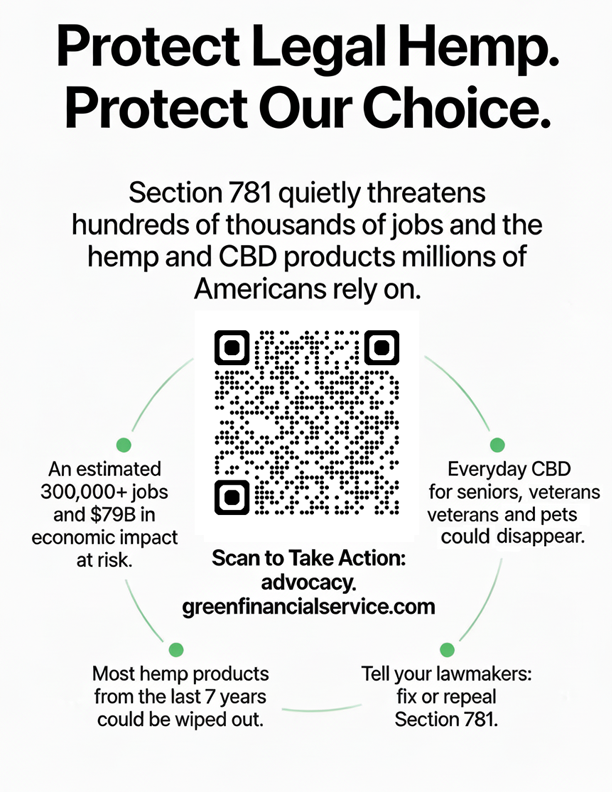
8.5x11 Version 2
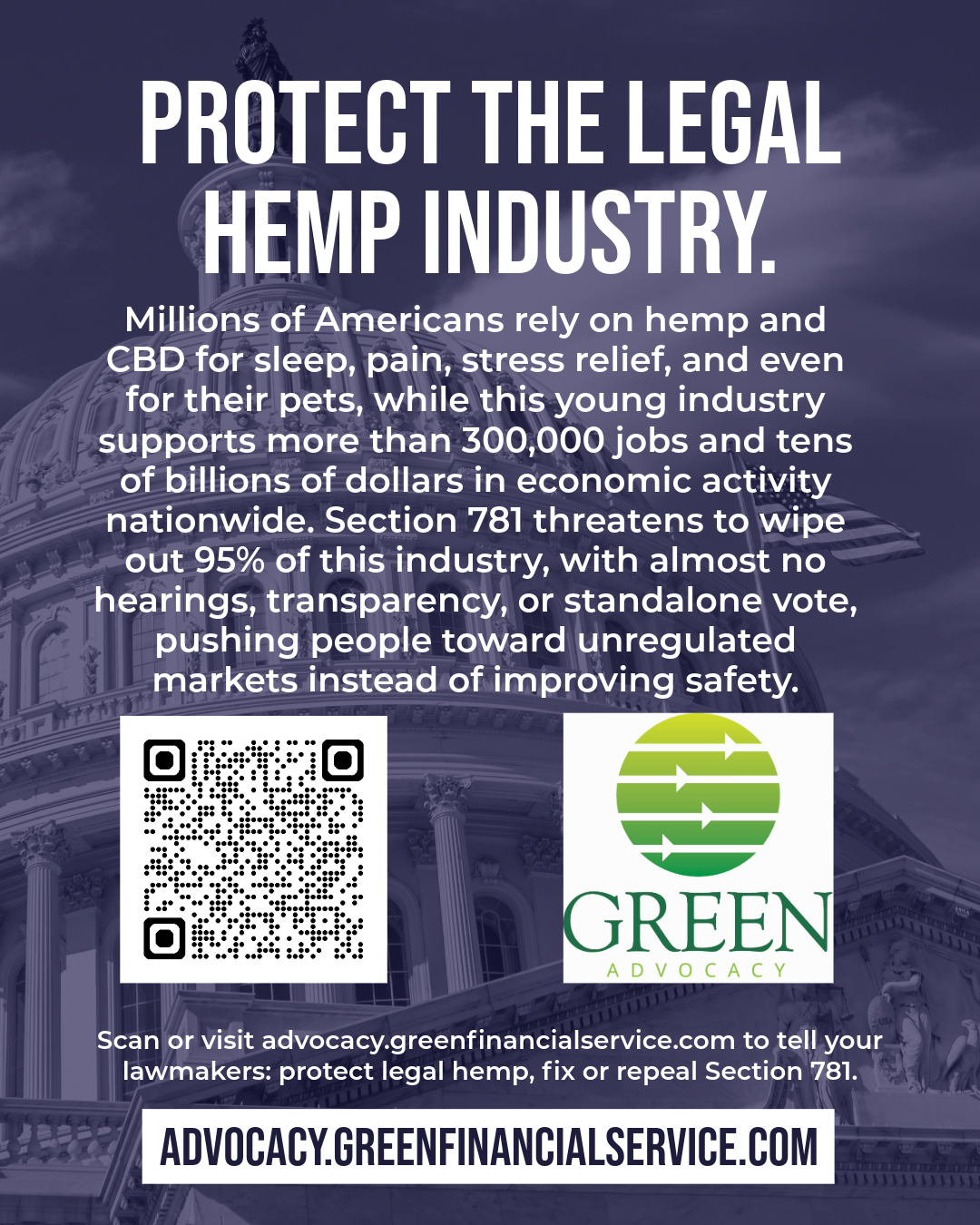
8.5x11 Version 3
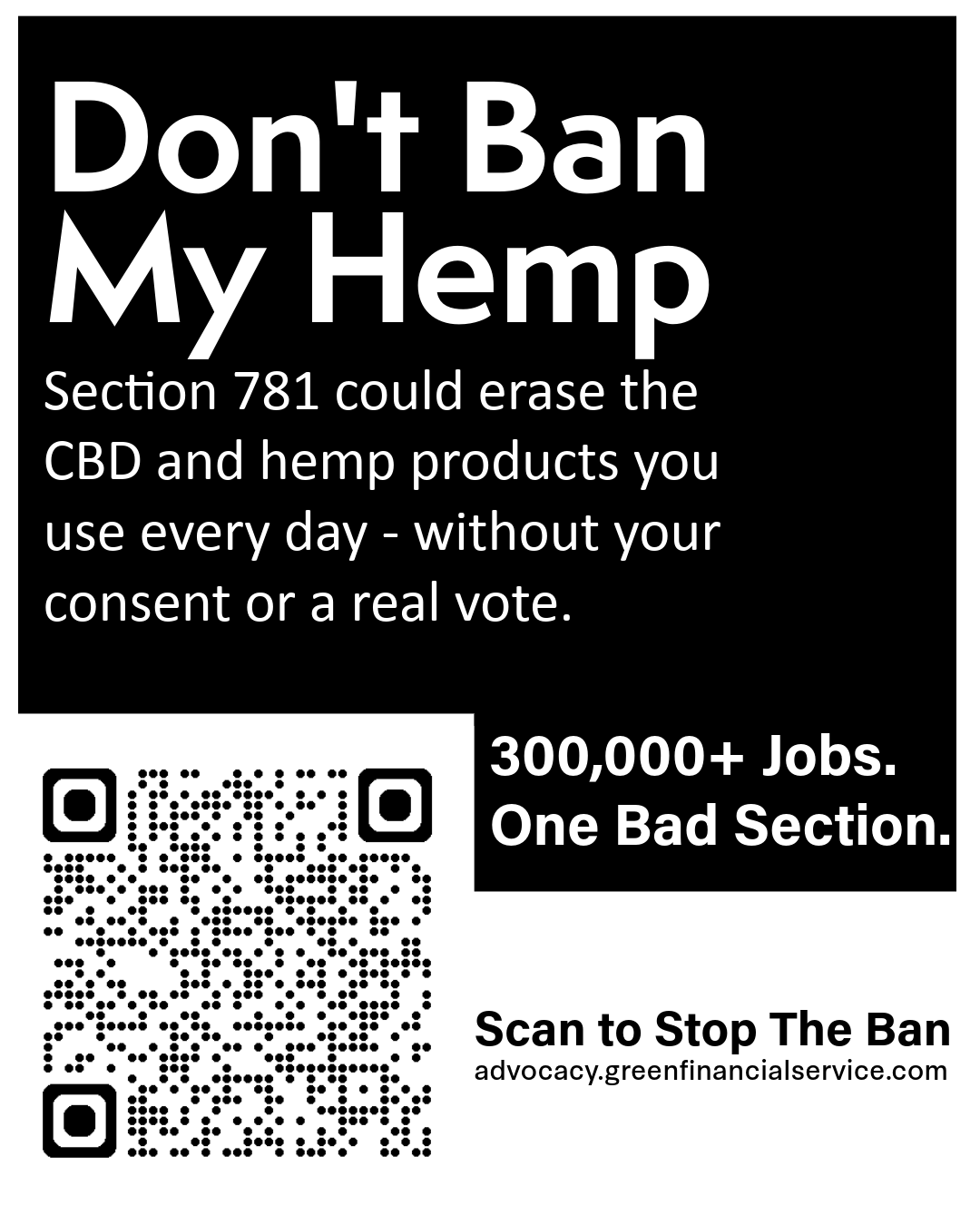
8.5x11 Version 4
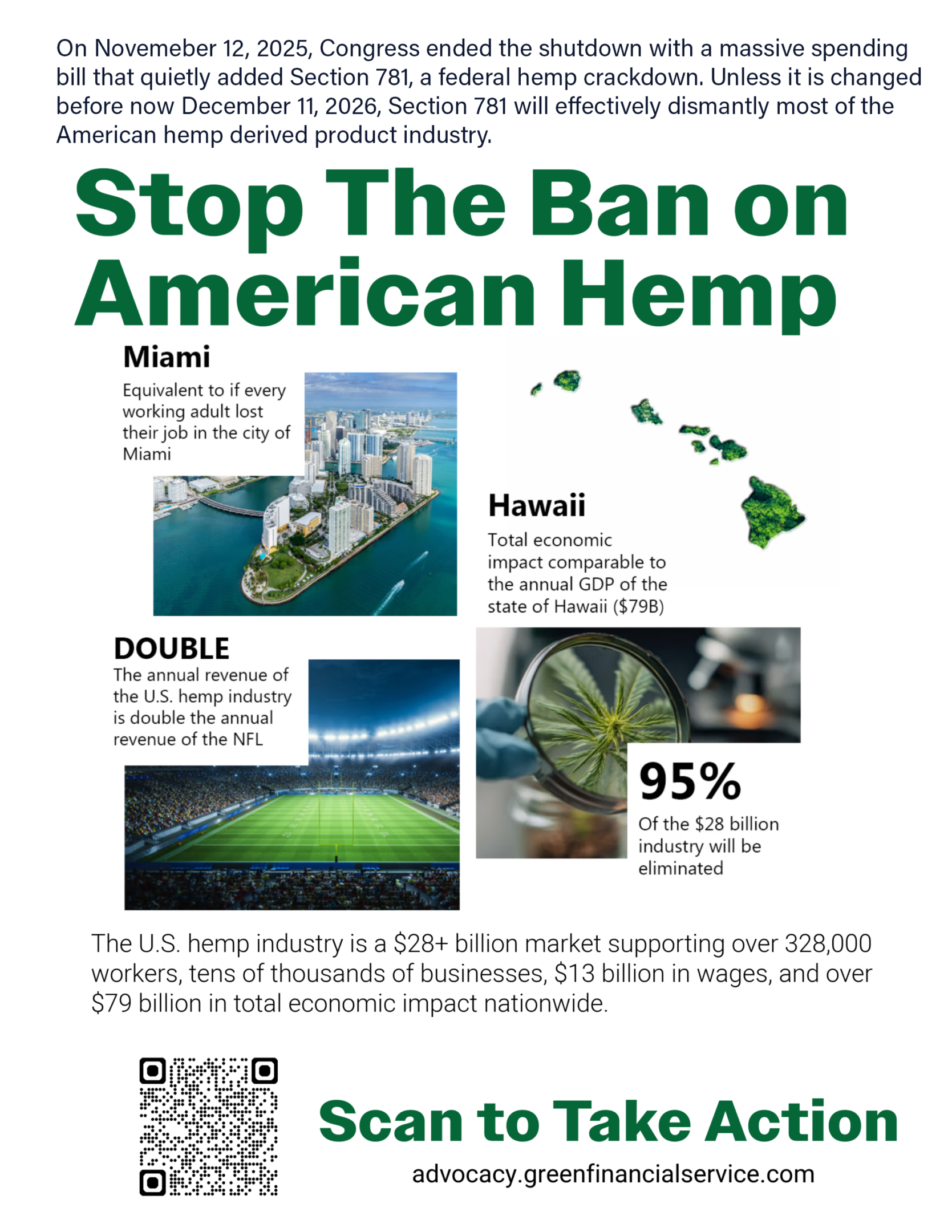
Badges for Websites
Large Badge
Share this 300×250 ad on your site
Copy and paste the code below anywhere in your site’s HTML where you want the ad to appear.
Medium Badge
Protect Legal HempAdd your voice. Take action.
Add this badge to your website
Copy and paste the code below anywhere in your site’s HTML where you want the badge to appear.
Medium Horizontal Badge
 Protect Legal Hemp – Take Action
Add this badge to your website
Small Horizontal Badge
Protect Legal Hemp – Take ActionAdd this badge to your website
Compact “Button” Badge
Speak Up on Section 781
Add this badge to your website
Stacked Badge + Text
Join the effort to protect legal hemp
Click to contact Congress about Section 781